

Papua-Insects.nl
The Papua Insects Foundation
about
us: 


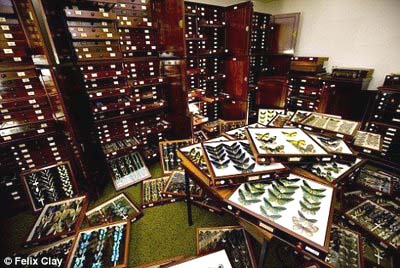
a part of the Rothschild collection before auction
early entomologists
with a brief biography
The most important and respected historical entomologists relevant for the natural history of New Guinea are reviewed here. The material they studied was generally collected by explorers who did not study the insects themselves. We like to emphasize that this page is under continued construction and will grow in time. If you have important additions for this list we would be grateful to receive your information and/or pictures.
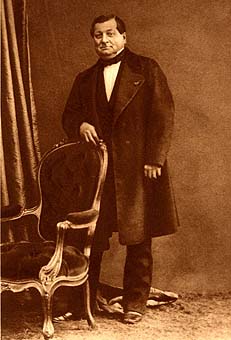
Jean Baptiste Boisduval (1799 - 1879)
Jean Baptiste Alphonse Dechauffour de Boisduval (June 17, 1799 – December 30, 1879) was a French lepidopterist and physician. He developed the Boisduval scale and identified many new species of butterflies. One of the most celebrated lepidopterists of France, he was the co-founder of the Société Entomologique de France. Early in his career, he was interested in Coleoptera and allied himself with both Lacordaire and Latreille. He was the curator of the Pierre Françoise Marie Auguste Dejean collection in Paris and described many species of beetles, as well as butterflies and moths, resulting from the voyages of the Astrolabe, the expedition ship of Jean-François de Galaup, and collected by Jules Sébastien César Dumont d'Urville. Boisduval's Elateridae are in the Natural History Museum, London and the types of Curculionidae in Brussels Natural History Museum. His Lepidoptera were sold to Charles Oberthür, a part of which is now in the Natural History Museum in London. The Sphingidae are in the Carnegie Museum of Natural History in Pittsburgh, Pennsylvania.
complete biography on Wikipedia
Gustaaf Hulstaert (1900 - 1990)
Gustaaf Hulstaert (5 July 1900 – 12 February 1990) was a Belgian missionary and naturalist. Entomology was his first love. In Belgium he collected and studied insects, also those from New Guinea and other parts of Indonesia which were sent to him by colleague missionaries in The Dutch Indies. When he was sent to the Belgian Congo on 15th September 1925 it did not keep him from his hobby. The list of his publications is impressive: 11 in 1923, 9 in 1924, one in 1925 and one in 1926, totaling 130 pages. His important collection is stored in the Naturalis Biodiversity Center in Leiden, The Netherlands.
Hulstaert followed his education at the school of "Missionarissen van het Heilig Hart" (Missionaries of the Holy Heart) in Asse, Belgium. His residence was Heverlee. He studied tropical medicine in Antwerp. In 1917 he became a member of the Missionaries of the Holy Heart and in 1924 he became priest.
In his career of 65 years as missionary in Belgian Congo he was a Father, school director in Flandria (Boteka), director of the seminary in Bokuma and from 1936 till 1951 he settled in Bamanya as religious prior and inspector of the mission schools. After that he was free to do his scientific work, in Church and entomology.
He studied the language and culture of the Mongo people and published a dictionary and several books of their culture and language. Moreover, his list of publications is impressive. More than 400 publications came from his hand: ethnographic, cultural, religious and entomological literature. In 1937 he founded, together with Father Boelaert, the scientific magazine Aequatoria of which he was the editor for 25 years. He was member of the "Koninklijke Academie voor Overzeese Wetenschappen" (Royal Academy of Kolonial Science) and volunteer scientist at the Museum for Central Africa in Ter Vuren. He was honoured for his massive scientific work and became the doctorate "honoris causa" of the university of Mainz (Germany) and Kinshasa (Democratic Republic of Congo).
Entomology
Before Gustaaf Hulstaert was sent as missionary to Belgian Congo in 1925 he studied the insects, and particularly the butterflies and moths, of the former Dutch Indies, including Dutch New Guinea. The material was sent to him by several colleague missionaries in that region. Unfortunately the specimens were very often in a poor state when they arrived in Heverlee, the residence of Hulstaert in Belgium. Nevertheless Hulstaert took the effort to study, identify and, when according to him necessary, describe many species as new to science. Unfortunately Hulstaert had probably no opportunities to visit important natural historic collections or had no access to major taxonomical literature, because many of his described species turn out to be junior synonyms. He must have known early of his future position as a missionary in Belgian Congo, because he was in a hurry; all the important publications on Indonesian butterflies and moths were published in 1923 and 1924. A part of his Belgian private collection of Lepidoptera still exists and is stored in the Lepidoptera collection of the Naturalis Biodiversity Center in Leiden, as are all his type specimens of Lepidoptera from the Dutch Indies. His African material is stored in the Museum for Central Africa in Ter Vuren, Belgium.
Literature concerning New Guinea Lepidoptera
Hulstaert, G., 1923. On Lepidoptera from New Guinea, Kei, Tenimber, the Philippines, and Australia. Annals and Magazine of Natural History (9)11: 178-190.
Hulstaert, G., 1924a. New Indo-Australian Noctuidae. Annals and Magazine of Natural History (9)13: 97-127.
Hulstaert, G., 1924b. New moths from New Guinea, Kei, and Tenimber. Annals and Magazine of Natural History (9)13: 127-139.
Hulstaert, G., 1924c. Heteroceres indoaustraliens nouveaux. Annales de la Société Entomologique de Belgique 64: 85-101.
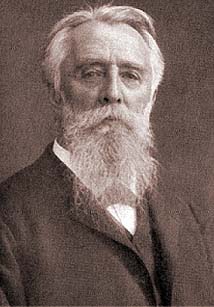
Arnold Andreas Friedrich Pagenstecher (1837 - 1913)
Pagenstecher was the son of Ernst Alexander Pagenstecher and Gattin Johanna Scherbius. He went through the humanistic Gymnasium in Wiesbaden and graduated in 1855 at the University in Würzburg, Berlin and Utrecht as a medical doctor. In 1861 he returned to Wiesbaden and assisted in the ophthalmology hospital of his cousin Alexander Pagenstecher. In 1876 he became a member of the medical council in Germany and in 1896 he entered the "secret"medical council.
From 1868 till 1880 Pagenstecher was a member of the Council board of Wiesbaden, in 1891 Town Council and in 1902 chairman of the Town council of Wiesbaden. In honour of is goodwill for the City of Wiesbaden he became in 1907 honorary citizen of Wiesbaden.
Besides his medical and political profession Pagenstecher was from 1882 till 1900 employed as Secretary of the Nassauischen Vereins für Naturkunde and as Inspector of the Naturhistorischen Museums Wiesbaden. After fusion and incorporation of the three museums in Wiesbaden by the council Pagenstecher became in 1900 director of the Naturhistorischen Museum.
Because of a severe lack of space for the scientific collection Pagenstecher planned together with Heinrich Fresenius (1847-1920) a new building for the museum at the presently Friedrich-Ebert-Allee. Preparations and planning of the new building took a long time. When the builing actually begun in 1913 Pagenstecher died.Scientific work
Most important in his entomology study were the Lepidoptera, of which the Swallow Tails (Papilionidae) of Southeast Asia form the major part. He was able to study much material from all kind of regions of the world which resulted in his great knowledge on the biogeography of many species groups. In 1909 he published his important work "Die geographische Verbreitung der Schmetterlinge in Jena". All together he produced more than 90 scientific publications with more than 250 newly described Lepidoptera species.
In the Museum of Wiesbaden he made a main collection of Lepidoptera which he expanded by gathering many important private collections of i.e. M.J. Bastelberger, August Fuchs and Adolf Rössler. With more than 600,000 specimens and hundreds of types it is at present still a very important scientific collection. Apart from his own Papilionidae collection he owned a worldwide collection of Apollo Butterflies (Parnassiinae). Pagenstecher also published and described many Papuan species.In 1908 he became honorary member of the Nassauischen Vereins für Naturkunde.
complete biography on Wikipedia (in German)
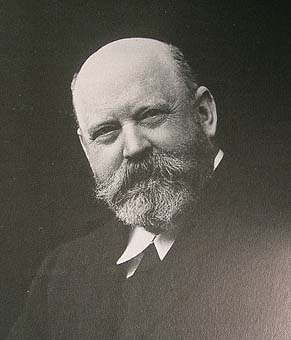
Lionel Walter Rothschild (1868 - 1937)
Lionel Walter Rothschild, 2nd Baron Rothschild, (February 8, 1868 – August 27, 1937), was a British banker, politician, and zoologist.
He was the eldest son and heir of Lord [Nathan] Rothschild, an immensely wealthy financier and the first unconverted Jewish peer in England.
The eldest of three children, Walter was deemed to have delicate health and was educated at home. As a young man he traveled in Europe, attending the university at Bonn for a year before entering Magdalene College at Cambridge. In 1889, leaving Cambridge after two years, he was required to go into the family banking business to study finance.
At the age of seven, he declared that he would run a zoological museum. As a child, he collected insects, butterflies, and other animals. Among his pets at the family home in Tring Park were kangaroos and exotic birds. At 21, he reluctantly went to work at the family bank, N M Rothschild & Sons in London. He worked there from 1889 to 1908.
He evidently lacked any interest or ability in the financial profession, but it was not until 1908 that he was finally allowed to give it up. However, his parents established a zoological museum as a compensation, and footed the bill for expeditions all over the world to seek out animals.
Rothschild suffered from a speech impediment and was very shy, but he had his photograph taken riding on a giant tortoise, and drove a carriage harnessed to six zebras to Buckingham Palace to prove that zebras could be tamed.
Though he never married, Rothschild had two mistresses, one of whom bore him a daughter.Zoological career
Rothschild studied zoology at Magdalene College, Cambridge. Meeting Albert C.L.G. Günther sparked his interest in the taxonomy of birds and butterflies.
Although Rothschild himself traveled and collected in Europe and North Africa for many years, his work and health concerns limited his range, and beginning while at Cambridge he employed others - explorers, professional collectors, and residents - to collect for him in remote and little-known parts of the world. He also hired taxidermists, a librarian, and, most importantly, professional scientists to work with him to curate and write up the resulting collections: Ernst Hartert, for birds, from 1892 until his retirement at the age of 70 in 1930; and Karl Jordan for entomology, from 1893 until Rothschild's death in 1937.
At its largest, Rothschild's collection included 300,000 bird skins, 200,000 birds' eggs, 2,250,000 butterflies, and 30,000 beetles, as well as thousands of specimens of mammals, reptiles, and fishes. They formed the largest zoological collection ever amassed by a private individual.
He was the first to describe the Rothschild giraffe (Giraffa camelopardis rothschildi], a subspecies with five horns instead of two, which was named after him. It is also known as the Ugandan or Baringo Giraffe, and is the most endangered of the nine subspecies. Another 153 insects, 58 birds, 17 mammals, three fish, three spiders, two reptiles, one millipede, and one worm also carry his name.
Rothschild opened his private museum in 1892. It housed one of the largest natural history collections in the world, and was open to the public. In 1932 he was forced to sell the vast majority of his bird collection to the American Museum of Natural History after being blackmailed by a woman. In 1936 he donated the rest of the collection to the Trustees of the British Museum. The Walter Rothschild Zoological Museum at Tring is now a division of the Natural History Museum.
Rothschild was awarded an honorary doctorate by the University of Giessen in 1898, was elected a Trustee of the British Museum in 1899, and was elected a member of the Royal Society in 1911.complete biography on Wikipedia
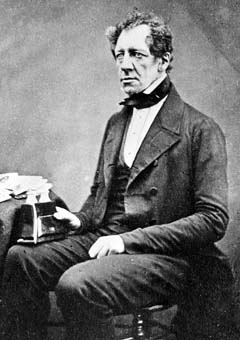
Francis Walker (1809 - 1874)
Francis Walker was born in Southgate, England on 31st July 1809 and died at Wanstead, England 5th October 1874. Walker was employed by the British Museum of Natural History (BMNH) as a curator between 1844 and 1873. Francis Walker was one of the most productive writers in entomology, he wrote 87 scientific papers. He described almost 20,000 new insect species, but, unfortunately, he was, sometimes a careless taxonomist, often describing the same species more than once under different specific names. A famous anecdote tells that he even decribed one species out of two different ones, because he had to stop with his description at the end of the day and started the next day with another species and continued with the same description! Another rumour is about Walker's fake descriptions of diatoms (phytoplankton algae), which wonderful and amazing skeleton shapes do indeed stimulate the phantasy of the mind. Later many of such invented species could be matched more or less with new discovered species from the oceans. The British Museum paid him 1 shilling for each new species and 1 pound for each new genus. He is best known for his catalogues of Orthoptera, Neuroptera, Homoptera, Diptera, Lepidoptera and Hymenoptera. Upon his death one (anonymous) obituary read: "More than twenty years too late for his scientific reputation, and after having done an amount of injury to entomology almost inconceivable in its immensity, Francis Walker has passed from among us". Despite his generally poor taxonomic reputation, Carvalho & Webb (2005) describe in detail the labelling of Walker specimens, which has generally led to confident selection of type specimens of the species he described.
Most of his described material is now in the BMNH and a smaller part in the Hope Collection of the Oxford University (OXUM).
updated on 17th November 2010
.jpg)